


Having grown up in London, tea has been around for as long as I can remember. You go to someone’s house = tea. You’re stressed = tea. Afternoon break, late-night revision, awkward chat with a neighbour = tea.
At school, my go-to was always an English breakfast with milk. Quite a lot of milk. Proper tea drinkers used to judge that the colour wasn’t “right,” too milky, not strong enough. But that was my tea. Familiar, comforting, unquestioned.
And that’s the thing about tea, we rarely question it. What I didn’t realise for years is that many of those everyday tea bags were quietly shedding microplastics straight into my mug.
What’s Actually in a Tea Bag?
Most people assume tea bags are paper.
Many modern tea bags, especially the smooth, silky pyramid ones, are made using plastic polymers like nylon or PET (polyethylene terephthalate). Even “paper” tea bags are often sealed with plastic glue to stop them falling apart in hot water.
In response to growing concern, some brands have begun shifting away from conventional plastics toward PLA (polylactic acid), a plant-based plastic made from renewable sources like corn starch. While PLA is plant-based, it is still a plastic polymer that behaves similarly under heat and typically requires industrial composting conditions to break down.
When you pour boiling water over plastic-based tea bags, those materials don’t just sit there. Researchers at McGill University found that a single plastic-based tea bag can release +11 billion microplastic particles and 3 billion nanoplastic particles into one cup of tea.
And unlike food packaging, tea feels pure, natural, almost medicinal, which makes the disconnect even more unsettling.
Why This Matters
Microplastics aren’t just an environmental issue anymore, they’re a human one.
They’ve been detected in blood, lungs, placentas, and digestive systems. While the long-term health implications are still being studied, what is clear is that exposure is increasing, and hot liquids are one of the most efficient ways for plastics to leach into what we consume.
For something as habitual as tea, something people drink multiple times a day, that exposure adds up quickly. What makes this even more uncomfortable is how the industry responds.
After concerns around plastic tea bags gained attention, the Tea Association of the U.S.A. released a statement explaining that materials like nylon and PET have been assessed for use in hot food and beverage applications.
In its statement, the association explained that materials commonly used in tea bags, including nylon and PET, have been assessed by regulators for use in hot food and beverage applications. But the line that’s hardest to ignore is this:
“The health effects of consuming micro- and nano-plastics to humans are not known.”
Tea isn’t an edge case, it’s a daily habit. And when something is consumed this frequently, “we don’t know” isn’t reassuring, it simply means the experiment is happening in real time.
The Irony of Tea
What makes this even more frustrating is that tea itself isn’t the problem.
Researchers at Northwestern University recently found that tea leaves can naturally adsorb heavy metals like lead from water during brewing, reducing the amount that ends up in your cup. In other words, the leaves themselves may actually make your water cleaner.
The irony is hard to ignore. The same drink that can help remove contaminants from water can also become a source of exposure, not because of the tea, but because of what we brew it in.
The Solution?
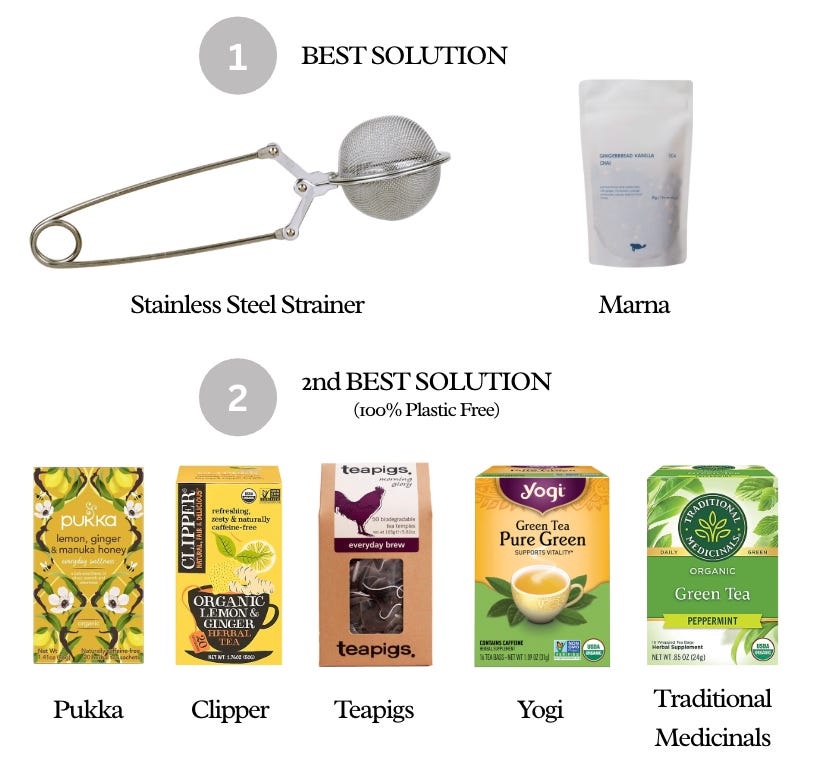
Loose-leaf tea aka no tea bag (i.e Marna) is the best solution as you are avoiding the issue completely. And if you’re not a fan of loose-leaf tea there are now genuinely plastic-free tea bags that make the switch easy, without compromising the habit.
You don’t need to change the ritual, just what holds it together.